
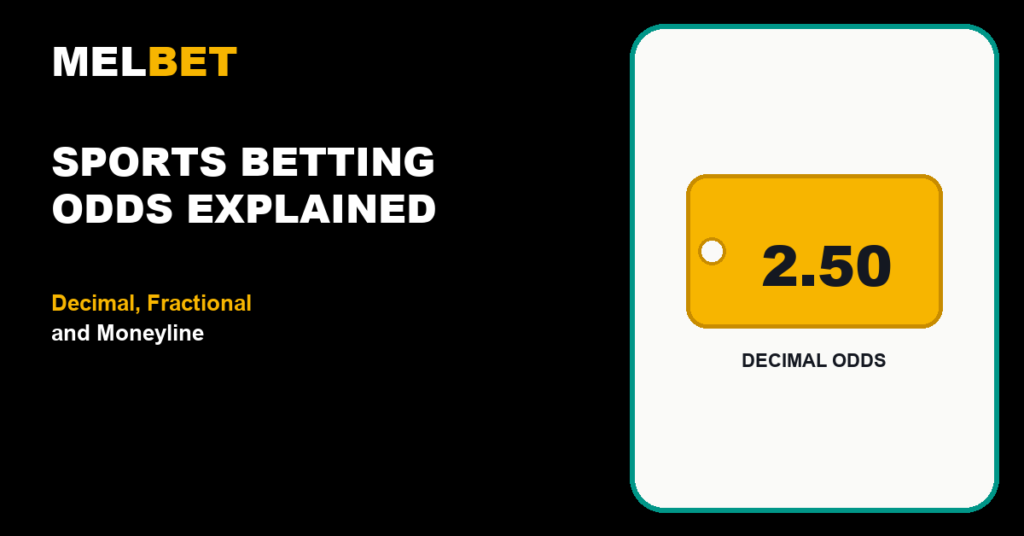
Every sportsbook shows odds differently, and if you have ever opened a betting slip and seen “2.50”, “3/2”, and “+150” used to describe what turns out to be the exact same bet, you already know the confusion. All three describe the same payout and the same implied probability — they are just different notations for one underlying number.
Once you can convert between them in your head, you stop being limited to whichever format a site defaults to, and you can compare value across bookmakers that use different display conventions without opening a calculator every time.
The Three Formats You’ll Actually See
Decimal Odds
The most common format on platforms serving Filipino and Asian bettors, including Melbet. Decimal odds show your total return per 1 unit staked, stake included. Odds of 2.50 on a ₱100 bet return ₱250 total if it wins — that is ₱150 profit plus your original ₱100 back.
Fractional Odds
Common on British and Irish platforms. Fractional odds show profit relative to stake. Odds of 3/2 mean a ₱100 stake profits ₱150 if it wins — the stake is returned separately, on top of that profit.
Moneyline (American) Odds
Common on US-facing platforms, shown as a positive or negative number. A positive number like +150 shows the profit on a ₱100 stake. A negative number like −150 shows how much you would need to stake to profit ₱100.
Converting Between Formats, With Real Peso Examples
These three numbers all describe the identical bet:
- Fractional 3/2 → divide 3 by 2, add 1 → Decimal 2.50
- Moneyline +150 → divide 150 by 100, add 1 → Decimal 2.50
- Moneyline −150 → divide 100 by 150, add 1 → Decimal 1.667 (the other side of the same match)
Once converted to decimal, every format lines up on the same scale, which is why decimal is the easiest format to compare bets in even if a site displays something else by default.
What Odds Actually Tell You About Probability
Decimal odds convert directly into an implied probability: divide 1 by the decimal odds. Odds of 2.50 imply a 40% chance of that outcome, according to the bookmaker’s pricing.
Add up the implied probabilities of every outcome in a market and the total comes to more than 100% — that extra percentage is the bookmaker’s built-in margin, often called the overround. It is how sportsbooks make money regardless of the result, and it means the “true” odds of any event are always slightly better than what is actually offered.
Why This Matters When Comparing Bets
Spotting value means comparing a bookmaker’s implied probability against your own honest estimate of how likely an outcome actually is. If you think a team has a 50% chance to win but the odds only imply 40%, that price has value regardless of which notation it was displayed in. This is the same thinking behind picking spots covered in our guide to the sports with the best betting value, and it only works once odds format stops being a barrier to comparing numbers quickly.
If you are building out a broader research habit before placing bets, our guide on analyzing football stats before betting covers the data side of the same decision.
Ready to put this into practice?
Pool-based betting works differently again, where the final price is not known until the off — see our guide to horse racing odds.
Frequently Asked Questions
Q: Which odds format is best for beginners? A: Decimal is generally the easiest to work with, since the number shown is your total return per unit staked with no extra addition needed.
Q: How do I convert fractional odds to decimal? A: Divide the numerator by the denominator, then add 1. For example, 3/2 becomes 1.5 + 1 = 2.50.
Q: What does a negative moneyline number mean? A: A negative number shows how much you would need to stake to profit ₱100 (or $100). −150 means staking ₱150 to profit ₱100.
Q: Why do implied probabilities add up to more than 100%? A: Because bookmakers build a margin, called the overround, into every market. That margin is how the platform earns money regardless of the outcome.
Q: Does the odds format affect my actual payout? A: No. Decimal, fractional and moneyline are only different ways of displaying the same underlying odds and the same payout — converting between them changes nothing about what you are actually betting on.
Final Thoughts
Odds notation looks more complicated than it is. Decimal, fractional, and moneyline are three windows onto the same number, and once you can convert between them, comparing bets across different platforms becomes a lot faster. Please gamble responsibly and only wager what you can afford to lose.