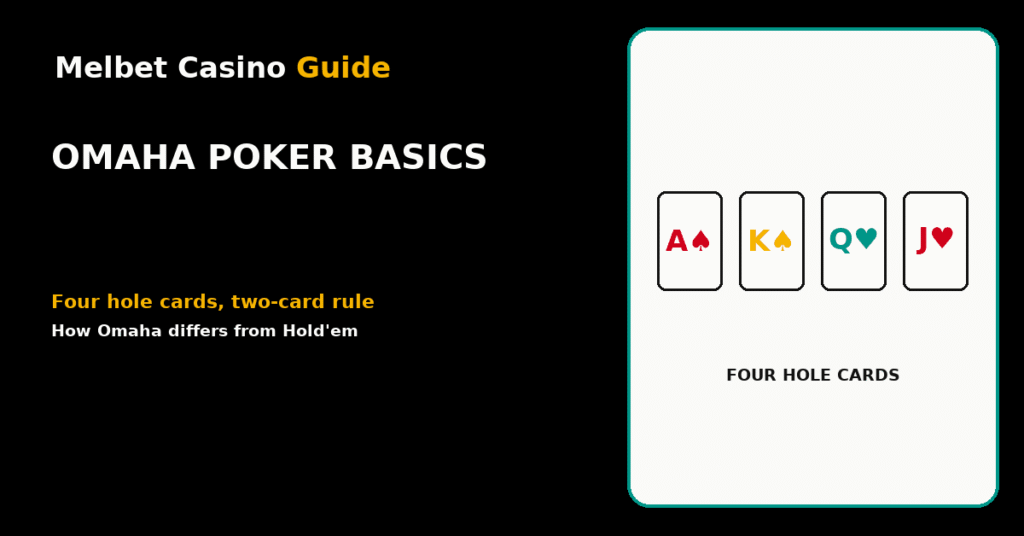
Quick answer: In Omaha poker every player is dealt four private hole cards instead of two, five community cards are dealt face up, and you must make your hand using exactly two of your hole cards and exactly three of the five board cards — no more, no fewer. That one rule changes almost everything about how the game plays compared with Texas Hold’em.
Legal note: this guide explains how the game works. Under Philippine law, only PAGCOR-accredited operators are confirmed legal for online gambling from within the Philippines, and informal games played for money are illegal gambling under Presidential Decree 1602. Melbet, the operator we link to, holds a Curaçao licence rather than a PAGCOR licence — see our Melbet games guide for details. Players must be 21 or older.
How an Omaha Hand Plays Out
The structure is the same as Hold’em. Two players post the small and big blinds, everyone receives their hole cards, and the hand moves through four betting rounds: pre-flop, the flop (three community cards), the turn (a fourth) and the river (the fifth). The best five-card hand at showdown wins the pot, or everyone else folds and the last player standing takes it.
The difference is the hand you are allowed to build. With four hole cards you have six possible two-card combinations, and the board offers ten possible three-card combinations, so there are many more ways to assemble a hand than in Hold’em — and many more ways to misread your own cards.
The Two-Card Rule in Practice
This is where most beginners slip. Because you must use exactly two hole cards, some hands that look obvious are not actually yours:
- Flushes. If the board shows three spades and you hold only one spade, you do not have a flush. You need two spades in your hand to pair with three on the board.
- Straights. Four cards in sequence on the board do not give you a straight unless you hold two cards that complete it using exactly two hole cards.
- Four of a kind. If the board shows four cards of the same rank, you still cannot use all four, because only three board cards may be played. To make quads you need one of that rank in your hand.
Hold’em lets you play the board outright or use just one hole card. Omaha never does. If you remember only one thing: count two from your hand, three from the table, every time.
Hand Rankings and Why the Nuts Matter More
The hand rankings are identical to Hold’em: royal flush at the top, then straight flush, four of a kind, full house, flush, straight, three of a kind, two pair, one pair and high card. What changes is how strong a hand you typically need to win.
With four cards each, players hold far more combinations and are far more likely to have made a straight, a flush or a full house by showdown. A hand that would be comfortably good in Hold’em — a single pair, or two pair — is often beaten in Omaha. That is why players talk about the nuts, the best possible hand on a given board. In Omaha, drawing to the nut flush or the nut straight is usually worth far more than drawing to a lesser version of the same hand, because second-best hands are expensive.
Pot-Limit, Hi-Lo and Other Variants
| Variant | How it differs |
|---|---|
| Pot-Limit Omaha (PLO) | The most commonly played form. The maximum bet or raise is the size of the pot at that moment. |
| Omaha hi-lo (Omaha 8 or better) | The pot is split between the best high hand and the best qualifying low hand (five unpaired cards, each eight or lower). The low must also use exactly two hole cards and three board cards. If no low qualifies, the high hand takes the whole pot. |
| Other structures | Some games are played fixed-limit or no-limit, but pot-limit is the standard. |
Pot-limit betting matters because it caps how fast the stacks can go in. Since many hands are close in strength in Omaha, a limit on bet size keeps the game from being decided by a single huge all-in on a coin-flip.
Starting-Hand Principles
Four cards means your hand is judged as a whole, not as two separate cards. The usual guidelines:
- Cards that work together. Four cards that connect with one another — for example K-Q-J-10 — can make many straights and strong pairs at once.
- Suited cards, especially “double-suited.” Two cards of one suit plus two of another gives you two flush chances. An ace of the suit is especially valuable because it makes the nut flush.
- Connected, not isolated. Cards that sit close in rank build straights; cards far apart rarely do.
- Avoid “dangling” cards. A dangler is a card that does not connect with the other three — like a lone 3 beside K-Q-J. It wastes a quarter of your hand.
- Pairs need support. A pair is much stronger when the other two cards are suited or connected than when they are unrelated.
Position matters here exactly as it does in Hold’em: acting last lets you see what opponents do first, and in a game with so many close hands that information is worth even more. If you like the structure of a poker hand and want to see a different table game where one fixed hand faces a dealer, our Caribbean Stud Poker guide covers a version with no opponents at all.
Ready to take a seat?
Frequently Asked Questions
Can I use just one hole card in Omaha?
No. You must use exactly two of your four hole cards and exactly three of the five board cards. Playing the board or using a single hole card, as you can in Hold’em, is not allowed.
Is Omaha harder than Hold’em?
The rules are only slightly more complicated, but the game is harder to play well. Hands are stronger on average, more players stay in, and misreading which hand you actually hold is a common and costly mistake.
What does PLO mean?
Pot-Limit Omaha: the most common way to play, where the largest bet or raise allowed is the current size of the pot.
What is Omaha 8 or better?
A hi-lo variant in which the pot is split between the best high hand and the best low hand, if a low qualifies. A qualifying low is five different cards ranked eight or lower, and it must also use two hole cards and three board cards.
Does the same hand ranking apply?
Yes. The ranking from royal flush down to high card is the same as in Hold’em, but you generally need a stronger hand to win at showdown.
Final Thoughts
Omaha rewards players who respect one simple rule — two from the hand, three from the board — and who understand that big hands run more often than in Hold’em, so second-best is an expensive place to be. Start with the principles above, fold weak, disconnected starting hands, and pay attention to position.
Poker involves risk, and skill does not remove the chance of losing. Only play with money you can afford to lose, and if betting has stopped being entertainment, use the deposit limit and self-exclusion tools your operator provides. 21+ only.