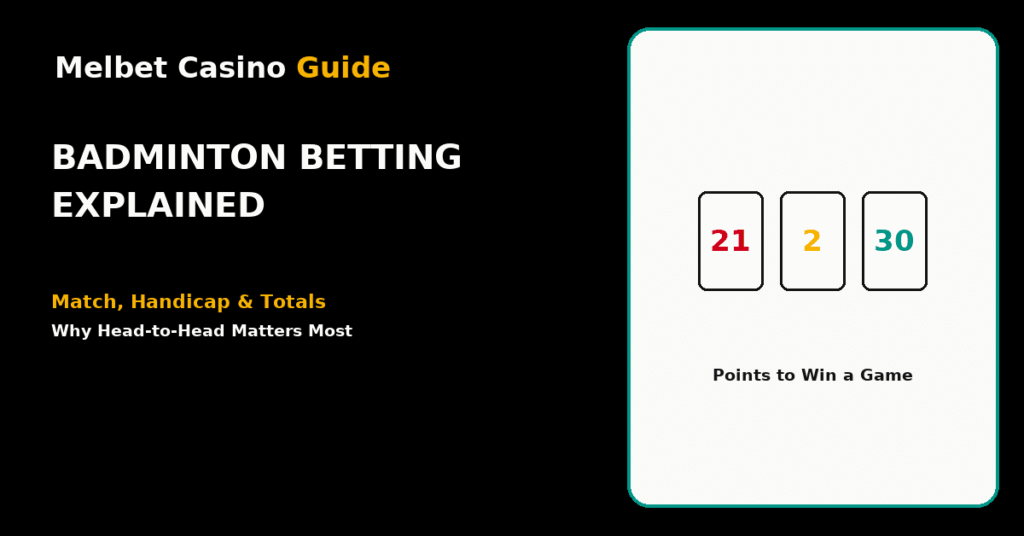
Quick answer: Badminton betting centres on three core markets — match winner, game handicap, and total points — built around the sport’s best-of-three, 21-point rally-scoring format. Because every game is capped at a tight, predictable point range, badminton handicaps and totals behave more like a compact, high-frequency version of tennis betting than like a football or basketball line, and head-to-head history matters more here than in most sports.
How a Match Is Scored
Matches are best of three games to 21 points, win by two, capped at 30 (a 29-29 score is settled by the next point). Since a rule change in 2006 moved the sport to rally-point scoring — where every rally wins a point regardless of who served — games run shorter and more predictably than under the old side-out scoring system, which is part of why in-play badminton markets move so fast.
The Three Core Markets
- Match winner. Straightforward moneyline on who wins the match outright, decided over up to three games.
- Game handicap. A points or games head start applied to even out a mismatched pairing — e.g. a favourite at −5.5 points in a game, or −1.5 games across the match.
- Total points (over/under). A combined-points line set across one game or the full match, settled the same way an over/under works in any other sport — see our over/under betting guide for how totals lines are built generally.
Correct-score markets (predicting a 2-0 or 2-1 match outcome) and first-game-winner bets are common too, priced as combination bets on top of the core three.
Why Handicaps Matter More in a Two-Game-Minimum Sport
A match needs only two games to finish, so a heavy favourite can win 2-0 without ever being seriously tested — which flattens the range of plausible final scorelines compared to a sport where a contest runs a fixed, longer distance regardless of how lopsided it is. That’s exactly why game and point handicaps carry real weight in badminton: a straight moneyline on a heavy favourite often prices in very little value, while the handicap line is where the market actually differentiates a comfortable win from a genuine blowout.
What Actually Moves Badminton Odds
- Head-to-head history. Elite badminton has a smaller player pool than most sports, and playing styles matter enormously — some players consistently struggle against a specific opponent’s shot selection regardless of world ranking, so H2H record carries more weight here than in most sports.
- Tournament schedule and fatigue. Top players compete on tour almost weekly, and a deep run the previous week is a real fatigue factor by the next tournament’s later rounds.
- Format — singles vs. doubles. Doubles matches move faster and are scored differently in practice (shorter rallies, more variance from partnership chemistry), so odds and totals behave differently than in singles even at the same skill level.
- Surface and hall conditions. Shuttle speed changes with altitude and air conditioning, which measurably affects rally length and total-points markets from venue to venue.
Common Mistakes
- Ignoring head-to-head record in favour of ranking alone. A lower-ranked player with a favourable stylistic matchup can be a live underdog even against a clearly higher-ranked opponent.
- Treating a 2-0 favourite as a lock. The two-game-minimum format means a strong favourite can still drop a game to variance without losing the match — a bet on the exact scoreline carries real risk a plain moneyline doesn’t.
- Betting totals without checking recent match lengths. A player’s average points-per-game against similar opponents is a better guide to a totals line than their overall win record.
Want to see live badminton odds?
Frequently Asked Questions
How many games does a badminton match go to?
Best of three games to 21 points, win by two, capped at 30 — a match ends as soon as one player or pair wins two games.
Can a badminton match end quickly at 2-0?
Yes — since only two games are needed, a dominant player or pair can close out a match in well under an hour, which is exactly why game handicaps exist to separate a comfortable 2-0 from a genuine blowout.
How do game handicaps work in badminton?
A points or games head start is applied to the underdog, the same way a run line or point spread works in other sports — the favourite must win by more than the handicap for that bet to pay out.
Is in-play betting available for badminton?
Where offered, yes, and the fast rally-point scoring means prices move quickly point to point — see our in-play betting guide for how live pricing generally works.
Final Thoughts
Badminton’s tight, two-game-minimum format makes head-to-head history and handicap lines matter more than they do in most sports — a player’s world ranking alone tells you less than how they’ve historically matched up stylistically against this specific opponent.
Set your session budget before the match starts and stop when it’s spent. If betting has stopped feeling like entertainment, use the deposit limit and self-exclusion tools your operator provides. 21+ only.